

and why this may be an early sign to focus on your lifestyle
Last week, a 42-year-old architect sat across from me, puzzled.
His blood tests were perfect…liver enzymes pristine, cholesterol controlled.
However his ultrasound (requested for mild right upper quadrant pain) revealed fatty liver.
“But I feel fine,” he said, tapping his fingers on the desk.
“Is this really something to worry about?”
It’s a question I hear often. Here is what I think.
General disclaimer: fatty liver is a condition with many potential causes. Proper diagnosis, determining the underlying cause, and creating a management plan require consultation with your physician or gastroenterologist. This article is for educational purposes, to help you understand the condition.
The stats and the definitions
Fatty liver disease affects 38% of adults globally.
That’s more than one in three people walking past you on the street.
Yet most don’t know they have it.
The liver can accumulates fat droplets quietly. No pain. No (initial) drama.
When more than 5% of its weight becomes fat, we call it steatotic liver disease.
The new term MASLD (metabolic dysfunction-associated steatotic liver disease) has replaced the old NAFLD (non-alcoholic fatty liver disease) label, removing the stigma while keeping the science intact.

The cascade from a healthy liver to cirrhosis. Fatty liver is reversible.
Ok…so what?
What creates this fatty accumulation? The usual suspects line up predictably.
Metabolic syndrome leads the charge…
That constellation of high blood pressure, elevated blood sugar, excess abdominal weight, and abnormal cholesterol that affects millions. Among those with type 2 diabetes, 65% have fatty liver. The numbers climb higher still in certain populations.
Poor sleep significantly increases fatty liver risk, with short sleep duration independently associated with MASLD development. Those catching less than five hours nightly? Their risk jumps considerably.
Even moderate improvements in sleep quality can reduce fatty liver risk by 29%. Sleep debt, it seems, is paid by the liver (and other important organs).
Stress plays its part too. Sleep deprivation triggers inflammatory responses and disrupts glucose metabolism, creating the metabolic chaos that fatty liver thrives in.
The modern lifestyle…rushed meals, truncated sleep, chronic stress….provides the perfect conditions for this silent condition to flourish.

Great article by the Cleveland Clinic https://my.clevelandclinic.org/health/diseases/10783-metabolic-syndrome
The absence of symptoms
Most people feel nothing. Absolutely nothing.
When symptoms do appear, they’re vague.
A dull ache in the right upper quadrant, perhaps.
Unexplained fatigue.
A general malaise that’s easy to blame on busy schedules or age.
These subtle signals often go unnoticed until the disease has progressed significantly.
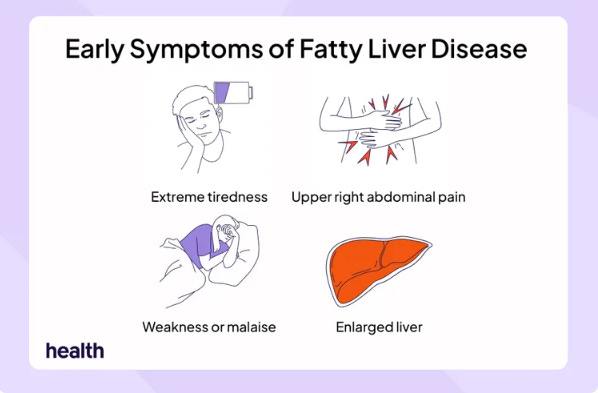
https://www.health.com/fatty-liver-disease-symptoms-8732516
So, what if you ignore it?
Untreated fatty liver does not remain completely benign.
Among those with fatty liver and type 2 diabetes, 66% develop MASH (metabolic dysfunction-associated steatohepatitis), the inflammatory form that damages liver cells. From there, the path leads to fibrosis, where scar tissue begins its slow encroachment.
About 15% progress to advanced fibrosis. The liver, once soft and pliable, becomes rigid with scars.
Function declines. Complications mount.
Eventually, some reach cirrhosis; that final chapter where the liver’s remarkable regenerative powers finally fail.
The timeline varies. Some never progress beyond simple fat accumulation.
Others move toward cirrhosis over decades. The difference often lies in those modifiable factors we discussed: weight, sleep, stress, movement.

Your liver can only withstand this type of burden for so long. https://hunterdongastro.com/non-alcoholic-fatty-liver-disease-nafld/
The future stats
By 2040, MASLD prevalence is projected to exceed 55% of adults.

Although speculative, given our current incidence and prevalence rates this is what the future holds
An epidemic unfolding in slow motion.
MASLD has already become the top indication for liver transplant in the United States for women.
What’s particularly concerning is the rise in younger populations.
Between 7-14% of adolescents now have MASLD.
While liver-specific deaths remain relatively low, cardiovascular disease remains the leading cause of death in MASLD patients.
The fatty liver, it seems, is often just one visible sign of systemic metabolic dysfunction.
Read about the foods I avoid eating to prevent fatty liver.

Kids love coke! Their liver probably doesn’t!
When fatty liver becomes cirrhosis
The progression from fatty liver to cirrhosis is NOT inevitable, but it’s increasingly common.
The liver, scarred beyond recognition, loses its ability to filter, produce, and regenerate.
For those wanting to understand the full picture of advanced disease, I’ve written extensively about decompensated liver cirrhosis when the liver finally loses its compensatory mechanisms.
The path back
Fatty liver can be reversed. The liver, given the right conditions, can heal back to normal.
The treatment is found in a pharmacy.
It’s written in lifestyle changes…sustainable, realistic modifications that accumulate like compound interest.
Weight loss of just 5-10% can dramatically reduce liver fat.
Add a Mediterranean diet, consistent sleep, managed stress, and regular movement, and you’re giving your liver the environment it needs to recover.
For a detailed roadmap on reversal strategies, including specific dietary approaches and the science behind them, see my guide on how to reverse fatty liver.
Take home point
That architect who visited last week?
He’s started taking evening walks, prioritising seven hours of sleep, and making small dietary shifts towards Mediterranean meals.
Consistent, sustainable changes that his liver will thank him for in years to come.
Fatty liver is NOT a diagnosis to panic over, but it’s not one to ignore either.
See it as an early but reversible warning sign.
A yellow light suggesting it’s time to re-assess.
The liver is remarkably forgiving, but even forgiveness has its limits.
Your liver is performing 500 different functions as you read this sentence.
Perhaps it’s time we returned the favour.
Struggling with digestive or liver issues that affect your daily life? Invest in your gut health with a private, personalised consultation where I will explore your specific symptoms and develop a targeted treatment plan. Take the first step toward digestive wellness today: https://bucksgastroenterology.co.uk/contact/
References
- Younossi ZM, et al. The Global Epidemiology of Nonalcoholic Fatty Liver Disease and Nonalcoholic Steatohepatitis Among Patients With Type 2 Diabetes. Clin Gastroenterol Hepatol. 2024;22(10):1999-2010.
- Younossi ZM, et al. Epidemiology of metabolic dysfunction-associated steatotic liver disease. Clin Mol Hepatol. 2025;31(Suppl):S32-S50.
- Liu Y, et al. Sleep factors in relation to metabolic-dysfunction associated fatty liver disease in middle-aged and elderly Chinese. J Clin Endocrinol Metab. 2022;107(10):e4250-e4257.
- Um YJ, et al. Sleep Duration, Sleep Quality, and the Development of Nonalcoholic Fatty Liver Disease: A Cohort Study. Clin Transl Gastroenterol. 2021;12(10):e00417.
- Wijarnpreecha K, et al. Insomnia and risk of nonalcoholic fatty liver disease: A systematic review and meta-analysis. J Postgrad Med. 2017;63(4):226-231.
- Jin S, et al. The impact of obstructive sleep apnea on nonalcoholic fatty liver disease. Front Endocrinol. 2023;14:1254459.
- Chen LD, et al. Non-alcoholic fatty liver disease among patients with sleep disorders: a Nationwide study of Taiwan. BMC Gastroenterol. 2020;20(1):32.
General Disclaimer
Please note that the opinions expressed here are those of Dr Hussenbux and do not necessarily reflect the positions of Buckinghamhsire Healthcare NHS Trust. The advice is intended as general and should not be interpreted as personal clinical advice. If you have problems, please tell your healthcare professional, who will be able to help you.