

Yep…we’re going there
Let me tell you a secret….
Donald Trump does a poo. Every day, probably.
Sydney Sweeney might have been holding one in during the Emmy Awards.
The Queen had bowel movements.
Einstein pondered physics on the porcelain throne.
We all do it.
Yet somehow, we’ve turned this most human of activities into society’s last taboo.
Which is ridiculous, really, because what comes out the other end gives us massive clues about our gut health.
And your gut health? Well, that affects everything from your mood to your immune system.
So let’s talk about poo.
And yes, I know….this newsletter is really hitting ground-breaking highs!
Disclaimer: A significant change in bowel habit requires urgent medical attention. Any concerns with your bowel habit requires medical attention.
Meet Your New Best Friend: The Bristol Stool Chart
Back in 1997, some scientists at Bristol Royal Infirmary decided to created a poo portfolio.
Seven types of stool, ranging from rabbit pellets to brown water. It sounds absurd, but this chart revolutionised how we discuss bowel health.
Think of it as a translator between you and your gut. Your intestines are constantly chatting away, and the Bristol Stool Chart helps decode the conversation.

Didn’t think you would be looking at this whilst having your breakfast? I’m not sorry. Bristol Stool Chart | Faecal | Continence Foundation of Australia

Here is a chocolate version to make you feel better
Type 1-2: The Concrete Situation

If this is coming out of your bottom, I got ya
Hard, separate lumps that hurt to pass. Like trying to birth a pine cone.
This is constipation, plain and simple. Your stool has spent too long in the colon, getting progressively more dehydrated as water gets reabsorbed.
The result? Rocks.
Sometimes, liquid stool can leak around these hard masses…
It’s called overflow diarrhoea.
Imagine a dam with water finding its way through the cracks. You think you have diarrhoea, but you’re actually constipated.
Common culprits include dehydration, lack of fibre, and sometimes abnormal calcium or thyroid levels.
The complications aren’t fun either – haemorrhoids from straining, bloating that makes you look six months pregnant, and in extreme cases, something called faecal impaction where things get properly stuck.
More fibre, more fluids, and maybe check out my guides on natural constipation remedies and medical laxative options Also, get your thyroid and calcium levels checked if this is your regular reality. If this change happens abruptly without any clear explanation, speak to a specialist.
Type 3: Nearly There

Close but no cigar
A sausage with cracks on the surface….
You’re close to greatness, just not quite there yet.
Add a bit more water and throw in some extra fibre. You’re on the right track, but your stool is telling you it could use more moisture. And please, for the love of your haemorrhoids, don’t strain. Which brings me to…
Buy a Squatty Potty. Or use a stack of books…sorry I meant a small stool (can’t be saying stuff like that on substack).
Elevating your feet while on the loo changes the angle of your rectum, making everything easier. One study found squatting position reduced time on the toilet from 130 seconds to 51 seconds. That’s less scrolling through Instagram and less risk of developing haemorrhoids.
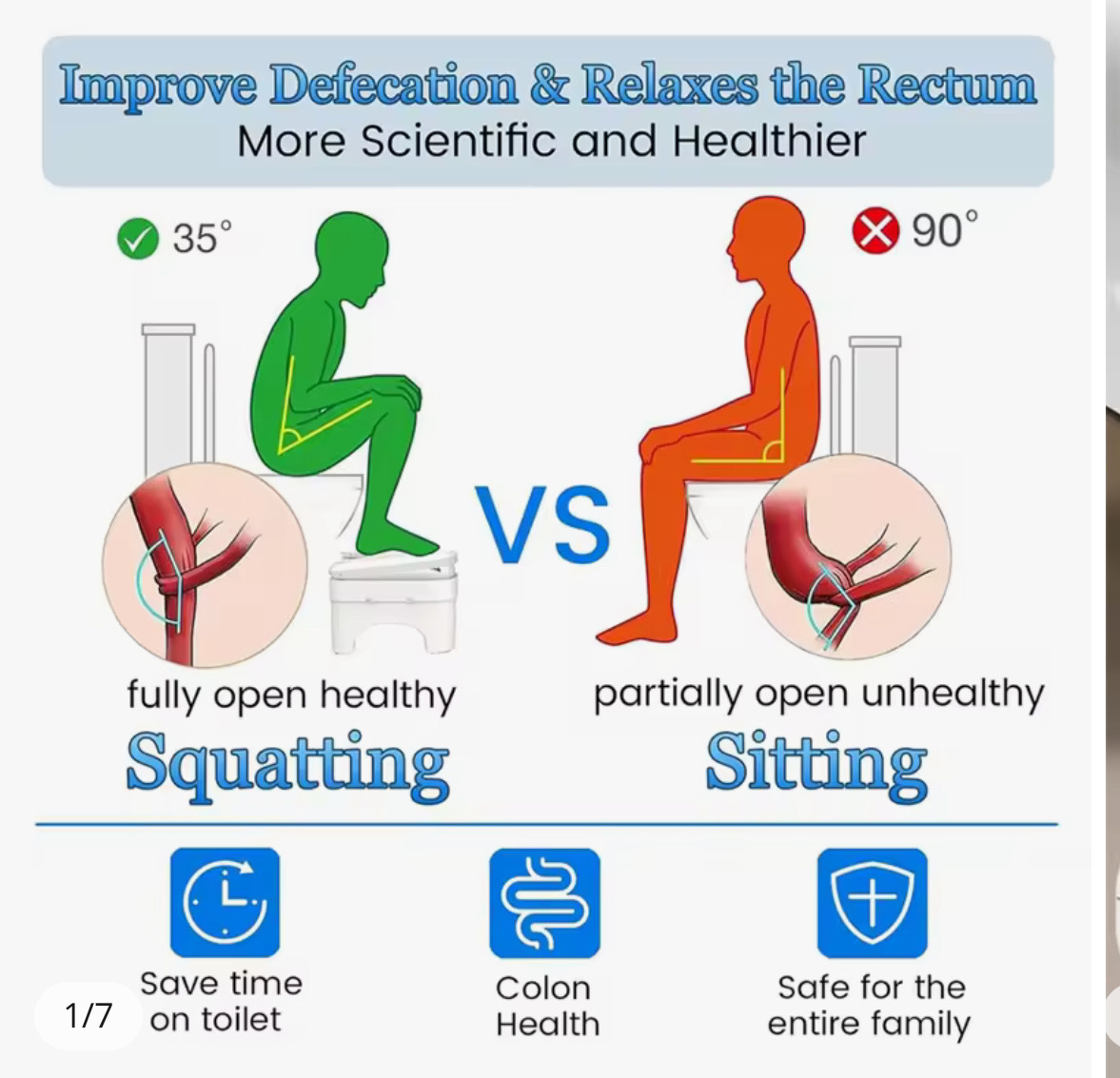
All in the angle
Type 4: The Gold Standard

Like smoooooth snake
Smooth, soft, snake-like.
This is the Goldilocks of poo…not too hard, not too soft, just right.
If this is you, congratulations. Your gut is happy. Your fibre intake is on point. Your hydration is perfect. Gold star for you. Seriously.
Type 5: Chicken Nuggets

not so delicious
Soft blobs with clear-cut edges, passed easily.
You’re entering borderline territory here. Yellow card!
While not quite diarrhoea, Type 5 suggests things are moving a bit too quickly through your system. Your gut transit time might be slightly accelerated…food is taking the express train rather than the scenic route.
This could be from too much coffee (guilty), a diet heavy in certain fibres, or mild food intolerances. Some people with IBS hover around Type 5.
If it’s occasional, probably fine. If it’s your everyday normal, maybe look at your diet. Are you overdoing the fruit? Drinking too much caffeine? Chewing gum all the time? Your gut might be gently protesting. If this is new you should see a specialist to get blood and stool tests.
Type 6: Porridge Problems

If this is coming out of your bottom, time to get checked!
Fluffy, mushy pieces with ragged edges. A porridge-like consistency.
This is never normal. Something’s up.
Type 6 means your intestines are in fast-forward mode. Water isn’t being absorbed properly, and whatever’s causing this needs attention.
Could be an infection, IBS flare-up, or reaction to medication (antibiotics are notorious for this). Sometimes it’s your morning coffee staging a rebellion against last night’s curry.
If this lasts more than a few days, see your specialist for blood and stool tests +/- further investigations.
Type 7: The Waterworks

Houston….we have a problem!
Entirely liquid. No solid pieces at all.
This needs medical attention, especially if it persists. Your body is either trying to flush something out urgently (infection, food poisoning) or there’s an underlying issue affecting absorption.
Blood tests, stool samples, possibly a colonoscopy – your specialist will want to investigate.
Don’t mess around with chronic Type 7. Dehydration happens quickly, and the underlying cause needs identifying.
The “Bottom” Line (I had to do it)
Your poo is like a daily health report from your gut.
Significant changes matter more than individual episodes.
Everyone has the occasional Type 6 after questionable takeaway choices. But if your normal suddenly shifts, pay attention.
The path to perfect poo…Drink water. Eat fibre (25-30g daily). Move your body. Consider your toilet posture (seriously, the Squatty Potty thing works). And if things seem persistently off, don’t be embarrassed to talk to your doctor.
I have seen/heard it all. Trust me.
Remember: we all poo. Even Elon Musk. Even Jennifer Lopez.
It’s time we stopped being weird about it and started listening to what our bodies are trying to tell us.
After all, your gut has opinions. The Bristol Stool Chart just helps you understand what it’s saying.
Join my newsletter….improving your liver and gut health…one e-mail at a time!
https://drhussenbux.substack.com/
Struggling with digestive issues that affect your daily life? Invest in your gut health with a private, personalised consultation where I will explore your specific symptoms and develop a targeted treatment plan. Take the first step toward digestive wellness today: https://bucksgastroenterology.co.uk/contact/
References
- Blake MR, et al. Validity and reliability of the Bristol Stool Form Scale in healthy adults and patients with diarrhoea-predominant irritable bowel syndrome. Aliment Pharmacol Ther 2016;44(7):693-703.
- Sikirov D. Comparison of straining during defecation in three positions: results and implications for human health. Dig Dis Sci 2003;48(7):1201-5.
- Modi RM, et al. Implementation of a Defecation Posture Modification Device: Impact on Bowel Movement Patterns in Healthy Subjects. J Clin Gastroenterol 2019;53(3):216-219.
- Ho KS, et al. The Effect of Fiber Supplementation on Chronic Constipation in Adults: An Updated Systematic Review and Meta-Analysis of Randomized Controlled Trials. Am J Clin Nutr 2022;115(4):991-1003.
- Arnaud MJ. Mild dehydration: a risk factor of constipation? Eur J Clin Nutr 2003;57(Suppl 2):S88-95.
- Anti M, et al. Water supplementation enhances the effect of high-fiber diet on stool frequency and laxative consumption in adult patients with functional constipation. Hepatogastroenterology 1998;45(21):727-32.
- Tang S, et al. The Extracellular Calcium-Sensing Receptor in the Intestine: Evidence for Regulation of Colonic Absorption, Secretion, Motility, and Immunity. Front Physiol 2016;7:245.
- Zeng Y, et al. Associations of thyroid hormones with chronic diarrhea and constipation in euthyroid individuals. Front Endocrinol 2024;15:1395743.
- Fritz CD, et al. Red-flag signs and symptoms for earlier diagnosis of early-onset colorectal cancer. J Natl Cancer Inst 2023;115(8):909-916.
- USPSTF. Screening for Colorectal Cancer: US Preventive Services Task Force Recommendation Statement. JAMA 2021;325(19):1965-1977.
General Disclaimer
Please note that the opinions expressed here are those of Dr Hussenbux and do not necessarily reflect the positions of Buckinghamhsire Healthcare NHS Trust. The advice is intended as general and should not be interpreted as personal clinical advice. If you have problems, please tell your healthcare professional, who will be able to help you.